2026-2027 Researchers

Zihan Chen
Zihan Chen
Chen Zihan joins IGLP as a Visiting Scholar, PhD Candidate and Researcher at Law School of Tsinghua University, and Editor-in-Chief of Tsinghua China Law Review. His research fields cover theory of international law, international economic law, WTO law, and international environmental law. His current interest focuses on the impact of new technologies on international law fragmentation, including smart trade, green trade, and trade and gender issues. He pays special attention to the challenges of generative AI on international law regulation of cross-border digital trade, and the international trade compliance risks of EU Carbon Border Adjustment Mechanism. His doctoral research focuses on a pressing issue within international trade law: data and countervailing duty rules.
Chen holds a dual bachelor’s degree in Law and Public Administration and a Master’s Degree in International Law from Tsinghua University. He received the China Law Society Sun Wanzhong Law Achievement Award and was awarded the First Prize for Excellent Papers by the China World Trade Organization Law Research Society. He publishes theses of legal profession in both English and Chinese, including World Trade Review, Journal of World Trade, Journal of International Dispute Settlement, Law and Economy (Chinese), and publishes monographs such as Technological Change and Global Trade Governance (Chinese). He was also recognized for his performance in international moot courts such as the John H. Jackson WTO Moot Court Competition and International FDI Moot Court Competition, and received awards from UNDP Youth Maker Challenge and COP15 Youth Biodiversity Solution.
Regarding his leadership and professional experience, Chen founded the world’s first WTO youth research community, China WTO Law Research Society Youth WTO Association, and initiated the “Trade Young Program”. Currently, he is combining his PhD research with participation in major projects, including the National Social Science Fund and ministry-level projects.
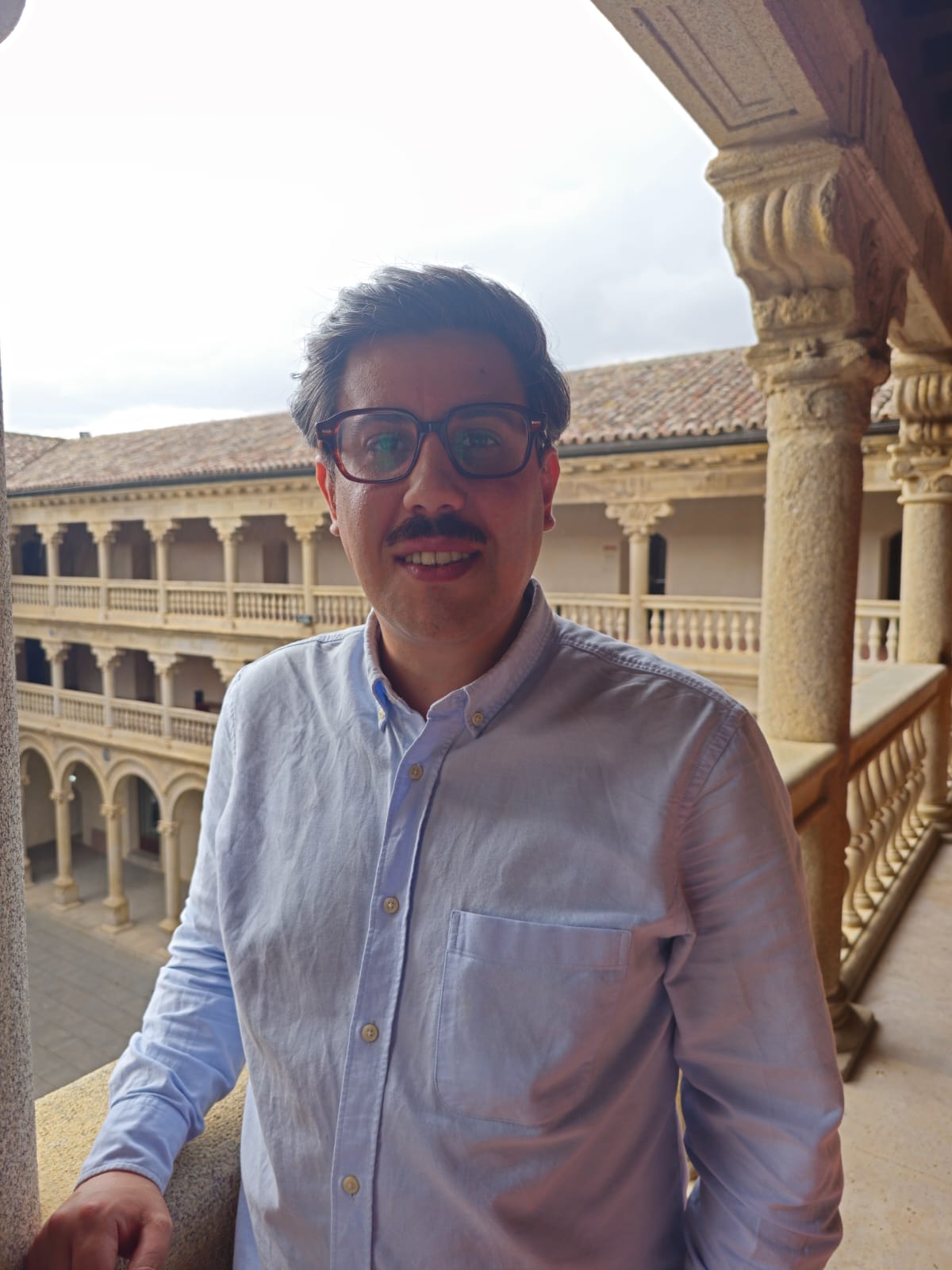
Faustino García de la Torre García
Faustino García de la Torre García
Faustino García de la Torre García is an Assistant Professor of Criminal Law at the University of Castilla-La Mancha (Spain), where he teaches both undergraduate and graduate courses in criminal law and legal theory. He holds a PhD in Criminal Law from the same institution. He graduated in Law with the Extraordinary Prize for Academic Excellence and completed a Master’s Degree in Constitutional Law, also awarded the Extraordinary Prize.
His research lies at the intersection of criminal law and constitutional theory, with a particular focus on the structural role of fundamental rights in shaping the limits of punishment, the principle of proportionality, and the constitutional foundations of criminal law. He has also developed a growing line of research in international criminal law, especially concerning models of attribution and the tension between individual culpability and collective forms of responsibility.
More recently, his work engages with the legal challenges posed by emerging neurotechnologies. In this context, he examines the implications of neurorights for criminal law, including issues of mental privacy, cognitive liberty, and the protection of personal identity. His research also addresses the concept of neurocrime and the potential transformation of criminal responsibility and evidentiary standards in light of neuroscientific developments. His broader aim is to contribute to the development of a normative framework capable of integrating technological innovation within the guarantees of the rule of law.

Tomás Benjamín Expósito Martínez
Tomás Benjamín Expósito Martínez
Tomás Expósito is a Ph.D. Candidate in Commercial Law at the Universidad Complutense de Madrid (UCM), where he is a recipient of the National FPI Fellowship awarded by the Spanish Ministry of Universities. His research focuses on corporate governance, internal control systems, and director duties, with a particular emphasis on the proactive monitoring of systemic risks.
At the IGLP, his project examines the legal nature and mandatory scope of oversight standards. By conducting a comparative analysis between the U.S. Caremark doctrine and the evolving European legal landscape he aims to determine to what extent adopting American oversight standards can enhance the liability framework for directors in the EU and Spain, providing a more robust shield against corporate misconduct.
In addition to his research, he serves as an elected member of the Commercial Law Department Council at UCM and works as a Lecturer in Commercial Law at both UCM and CES Cardenal Cisneros. He is an admitted attorney to the Madrid Bar Association (ICAM) and holds an LL.M. in Legal Practice, where he received the “Jaime Guasp” Prize for Best Master’s Thesis, as well as an Advanced Master in Corporate Legal Consultancy.

Ana María López Ormazabal
Ana María López Ormazabal
Ana María López Ormazabal is a doctoral researcher in the area of Constitutional Law at the University of Oviedo, currently working on her thesis on the fundamental right to inclusive education under the supervision of Professor Benito Aláez Corral.
Her research aims to demonstrate that, although Article 27 of the Spanish Constitution does not explicitly state that education must be inclusive, such an interpretation should be derived in connection with the fundamental right to equality enshrined in Article 14 of the Constitution. Furthermore, her doctoral work is being carried out within the framework of a research project on the same topic (PID2023- 146139NB-100), led by Professor Benito Aláez as Principal Investigator.

Raghav Pandey
Raghav Pandey
Raghav Pandey is an Assistant Professor of Law and the Director of the Centre for Regulatory Studies at National Law University Delhi. His research focuses on the intersection of public law, economics, and state capacity, with a particular specialization in the insolvency frameworks of the Global South.
At IGLP, Dr. Pandey’s research will explore the concept of “Algorithmic Sovereignty” and the rise of the “Architectural State.” His project examines how the Indian state is shifting from bureaucratic regulation to governance through code, using Digital Public Infrastructure (DPI) to rewrite the social contract. He aims to theorize the constitutional implications of state capacity executed through APIs rather than administrative orders.
Dr. Pandey holds a Ph.D. from the Indian Institute of Technology (IIT) Bombay, where he authored the first doctoral study on India’s Insolvency and Bankruptcy Code (IBC). He has also published the first legal commentary on IBC jurisprudence. Beyond academia, he is actively involved in legal technology as the founder of Nyaysutra, an initiative adapting Large Language Models (LLMs) to Indian Common Law. He frequently writes on regulatory policy for leading national newspapers.